
Developing a Reading Habit, Revisited
some strategies that I've used over the years

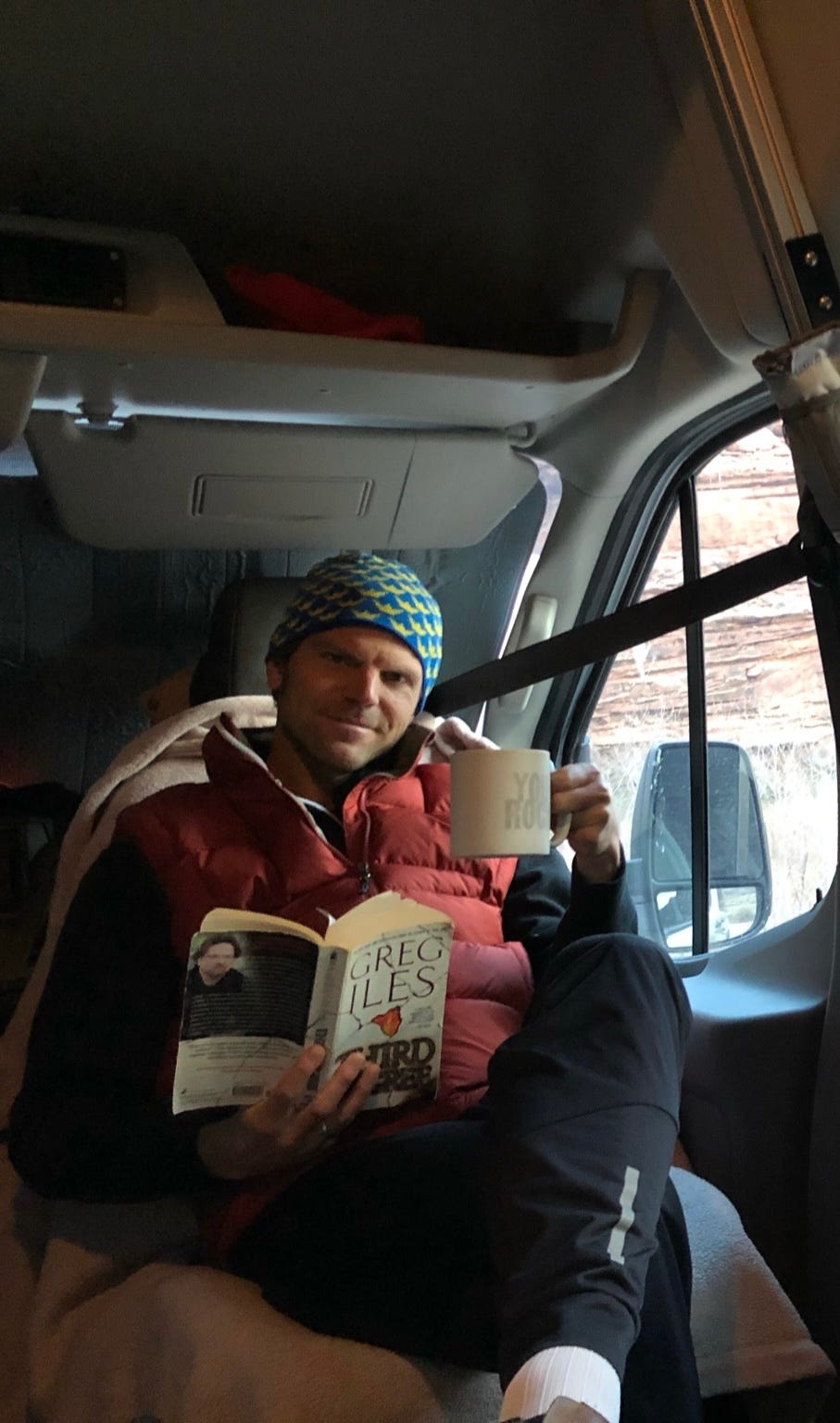
In 2018, I was listening to a podcast with Brandon Stanton, the founder and creator of Humans of New York. In the podcast, Stanton reflected on his time in college where he began to read a series of biographies about key historical figures. Stanton set out to read 100 pages per day which was not related to any of his academic work, meaning that he was reading 100 pages per day in addition to whatever else he had to read for school.
Kinda impressive.
Somewhat fortuitously, at the same time I was listening to that podcast, I had been thinking about my own reading habits. While I was racing professionally, I would read books from time to time, but it was not something I habitually did on a daily basis. I would have a tendency to quickly read a book of interest with a sort of binge approach, but then go long periods of time without picking up another book.
I am not sure if I consciously realized it at the time or not, but when I listened to Stanton that day I decided that I would try to implement a strategy that might lead to a more established reading practice of my own. Instead of waiting around for an opportunity to read a lot for a few days every few months, maybe I could just make reading a part of my daily practices, much like training.
One of the benefits of when people do somewhat extreme things is that it can sometimes widen our perspective on our own capabilities. When Stanton said he read 100 pages/day it seemed like something I could never do, but it did lead me to ask myself how much I could actually commit to on a daily basis that would be sustainable on my busiest of days.
I decided that 25 pages/day seemed like a reasonable goal for me to try to target.
My intention was to commit to reading 25 pages/day for a while and then assess how effective and sustainable I was finding it to be.
As it turned out, the habit stuck.
Four years later, I took the time to reflect on this strategy when I wrote an article in March 2022 on my website called Developing a Reading Habit. I originally came up with eight strategies related to what I felt was effective for me and might be helpful for others who are seeking to try and find ways to develop their own reading habit. Today I want to add some additional ideas for anyone that might be interested in reading more than they currently do.
The eight points I included in that original article are listed below. In that version, the first point was actually listed as number seven, but I have moved it forward to emphasize how important I believe it is to developing a reading habit.
The original eight points from 2022
Always start with what you want to read as opposed to what you might think you need to read. Reading should be enjoyable. Admittedly, I do read some books I find to be highly challenging, but I also read books that are very easy to read and just tell a good story. Everything has its place and when you are trying to develop the habit of reading, nothing will do that better than the reading you see as enjoyable. There is no hierarchy of reading. Reading is reading.
Think about what you can do under almost any day’s/week’s conditions as opposed what you can do in best-case scenario conditions.1 How much can you consistently read 80-90% of the time? Not 100%, just 80-90%.2 There is no minimum you have to adhere to other than your own. While I chose to target 25 pages/day, someone else might choose to target 15 minutes 3x/week. There is no right or wrong way to do it. The key is to stick with it.
I did not set aside specific times of the day to read. While it might be helpful to initially set aside a specific time to read to start with, I would recommend remaining flexible. Something might get in the way of that from time to time and you don’t want to feel like all is lost if you miss your window.
Nothing needs to be 100%. I mentioned that in the second point. You will miss a day. Or days. That’s ok. Just get right back on the routine and head forward when you do.3
If and when I did miss a day, I did not read more the next day to make up for it. You don’t want to make up for missed sessions, just keep it rolling.4 Conversely, I also didn’t bank pages. If I happened to read 50 or 75 pages in a day I still had to read 25 the next day. I was not working on averages, but on daily minimums. I found this to be the better long term strategy because it did not create an incentive to binge and reinforced the development of a consistent habit rather than a collective volume focus.
Almost all books I read are physical and not through any devices (personal preference, not a suggestion). However, I do keep a handful of books on an App on my phone. These books tend to be the type of books that do not read like one long narrative. They can be read a chapter or so at a time without needing to remember what happened recently. I kept these on hand for when times would get busy. I could always pull out a book, instead of just aimlessly scrolling, when I had dead time waiting somewhere. Again, these sorts of books need to be more like a collection of essays in case you go a long time between readings. I found this to be helpful in getting in the minimum on the busiest and most hectic of days.
I recently saw a suggestion of someone saying that they use the books they read to find the next books they are going to read. This is something I noticed myself doing, but not something I had considered at the outset. For example, I wanted to read a lot of successive presidential biographies, but would often get sidetracked from wanting to read about something I learned along the way. This always kept new books coming in that were waiting on the shelf. I didn’t necessarily go straight to them, but I started to have a reading pipeline that made it easier to not have lapses in having a wide variety of books on the ready. This can send you way off course sometimes and can really be a fun way to find yourself in unknown territory. I never considered myself to be overly interested in art, but found myself reading a Van Gogh biography as a result of one of these rabbit holes. You never know where your interests will take you from the reading you do.
Eventually it’s ok to give up the structure. I stuck to the 25 page minimum plan for a long time, but I eventually stopped keeping track as it no longer felt helpful or necessary.
2026 Updates
The points from 4.5 years ago have managed to hold up, but it is not an exhaustive list; I think it could be enhanced by incorporating the additional points below that I have since applied.
People spend way too much time reading books they don’t like. It is ok to stop reading a book that you are not enjoying. Now granted, I am not saying you will like every book right away, but I have a general rule that if I am not interested around 20-25% into a book, I move on. In the case of biographies, I sometimes adjust that to 1/3, but regardless of the heuristic I use, I have stopped pushing through books simply for the sake of feeling the need to finish it. If you are struggling with the idea of quitting a book you don’t like, I recommend reading Quit by Annie Duke.
Try different types of books more often. In line with the point above, it’s important to try reading things that might not initially seem like they would appeal to you. If you have access to a library in your community, this is a great resource to try out different books. Moreover, it makes it easier to stick to the rule above about not finishing books you aren’t interested in. When you borrow a book from the library, there is no sunk cost involved. If you don’t like it, just stop, take it back, try another. In addition to libraries, Thriftbooks.com is a great resource to purchase inexpensive secondhand books and is where I buy the majority of the books I own.
Read More Fiction. I admittedly could probably benefit from following this advice more than I do, but I still follow it. I have often said that I think some of the deepest levels of honesty reside in fiction and it is one of the best ways into understanding different life experiences.
Carry books with you. I was recently headed out to coach and Brooke saw me put a book in my gear bag. She asked why I brought a book with me to practice and I told her that you never know when an opportunity might arise. Even if it isn’t that often, it’s always better to have an option you don’t use than no option at all. There are more obvious times when people carry books, such as traveling, but there are lesser obvious times like going into a waiting room (or practice) where these opportunities may exist.
I hope you have found some of these strategies and suggestions to be helpful. If you have some ideas that have worked for you, please consider sharing them with me and everyone else in the comments section below.
We’ll touch base again in 2030 to see what other ideas come to light in the next four years.
Throughout the summer I will be recording my weekly training for the Ötillö SwimRun World Champs which can be found HERE.
See: Why We Think This Time Will Be Different to read more about the planning fallacy and using best-case scenarios for predictions.
I think you want to try and stay in the 80-90% range for the sake of consistency when it comes to developing a habit. If you find this to be quite challenging, I would suggest lowering the daily target to increase the consistency as a first step. See Raise the Average.
This is one of the reasons I am against maintaining streaks of any kind in a myriad of contexts.
Athletes will often try to insist on making up for missed sessions, but in most cases, the best plan of action is just carry on and move forward.