
The 3-2-1 Routine

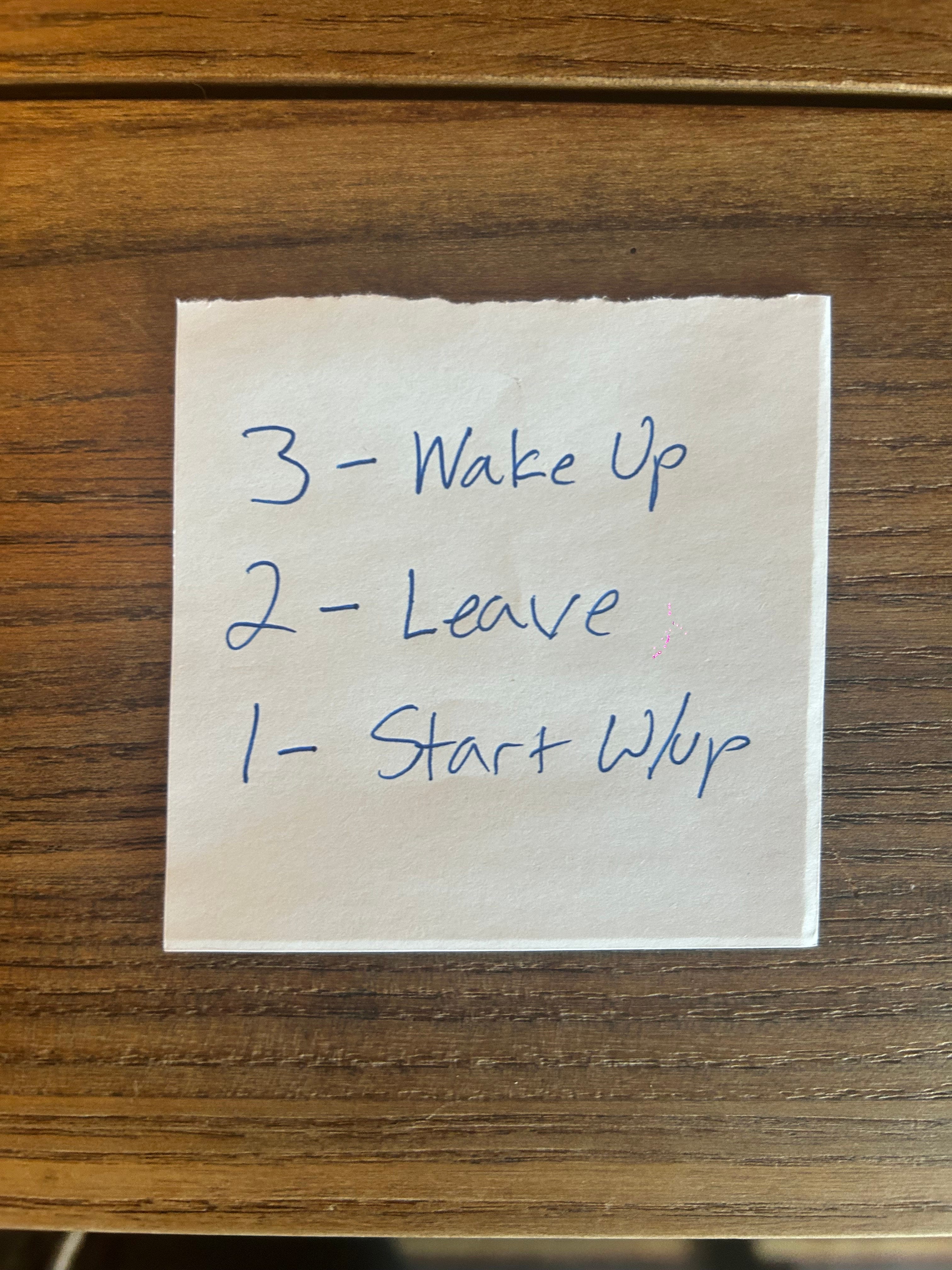
When I was racing, one of the strategies I used in different contexts was the use of routines; routines helped create a level of comfort and familiarity to apply to situations that might not feel that comfortable or familiar.
I think there is no better example of this than waking up on race morning.
While there were many race mornings that happened over the years, the races themselves were always different. Even if the race took place at a venue where I had raced before, the circumstances around it were always changing. My goals for the race may be different, the field may be different, the weather may be different, etc.
The main point is that each race had a level of unfamiliarity, but the pre-race routine I developed was familiar.
Over the years, through trial and error, I eventually landed on what I have called the 3-2-1 routine. I found it provided me with the Goldilocks amount of time on race mornings, where I had enough time to get everything done, but not so much that I found myself looking for things to do.
That routine consisted of:
Waking up three hours before the race start
Leaving for the race venue two hours before the race start
Beginning warm up one hour before the race start
No matter where I was racing or what time the race started, this is the template I eventually found myself working off of.
I believe the routine was effective for me because it was both incredibly simple and incredibly flexible.
For example, what I did between when I woke up and when I left was not specifically defined within the routine. I often tweaked what I ate for breakfast or what I might do for early morning activation, but the departure time remained fixed. Similarly, what I did for my warm up in the final hour might look quite different from one race to the next. Part of this had to do with what was available to (e.g., could you actually warm up for the swim) and how constrained the area might be.
Additionally, over time I came to find that certain components of the routine were more important to me than others. For me, this entailed having a full hour from when I woke up until the time I left for the race venue.
There were certain cases where race morning logistics were quite complicated. It might involve a longer morning commute, transferring between multiple transition areas, loading on/off buses, etc. If, and when, this was the case, I was less concerned about compromising other components of the race morning routine so long as I got my full hour from wake up to departure.
To ensure this was the case, if I needed more time to account for all the race morning logistics, I would simply wake up earlier to protect that hour.
For whatever reason, I did not mind if I was rushed getting ready in transition or getting ready to warm up, but it really bothered me to not have this time to ease into the day. Someone else might be completely different and might want to be more protective of another aspect of their race morning routines.
Creating your own pre-race routines
As you develop your own pre-race routine, the two components I would focus on would be making them simple and highly flexible. They need to be consistent enough to feel familiar, but flexible enough that they can be applied anywhere.
One of the reasons my pre-race routine was quite simple was because long course triathlon almost always began early in the morning. If I was lucky, I might get a 7:00 a.m. start time, but more often than not, those start times gradually crept closer and closer to 6:00 a.m. (which then meant a 3:00 a.m. wake up).
For other sports, this consistent pattern might not exist. Cyclists often have start times that vary from early in the morning to late at night, as do runners that race on the track. Nevertheless, I do think that working in that three-hour pre-race window is a good place to develop routines, even if the first step isn’t waking up. Moreover, you might divide your routines up a bit to account for pre-race routines for events taking place early in the day, and pre-race routines for events that take place later in the day.
Additionally, while routines maintain their effectiveness because they are, in fact, done routinely, it should not deter you from adjusting them over time. I did not create a 3-2-1 routine and then start to apply it. Instead, I came to it over time by trial and error, and by making adjustments that eventually provided me with something I felt comfortable in continuously repeating.
Formalizing a routine
While our discussion here has centered around routines in the hours before a race, routines are something that can be much longer, like a race week routine, or much shorter, like a routine an athlete performs immediately in the seconds before competing.1
The reason I bring this up is because we often have more of a routine that we realize, even if we have never specifically brought attention to it. Therefore, even if you don’t think of yourself as having routines, if you look more closely, you might realize that you do. By looking at what you already do, you can begin to take the steps that lead to formalizing an actual routine.
I would start by asking yourself:
What do I already seem to be doing?
What seems to be effective?
What might I be able to improve?
While those questions are not an exhaustive list of formalizing a pre-race routine, they can provide a good framework for progressing towards one.
Why do pre-race routines work?
There is a lot of research concerning pre-performance routines, but they are generally framed around routines in the immediate proximity before a performance.2 For example, a study might look at trying different pre-performance routines before a soccer player attempts a penalty kick. Generally speaking, in these sorts of studies, the simple introduction of the routine appears to be where the benefit lies, as opposed to what that routine actually consists of.
However, my suggestion of using a pre-race routine is not really about something being done just before the start gun goes off, but for several hours leading into it. Nevertheless, I believe that same concept applies, where having a routine is helpful, regardless of what it entails.
In my opinion, this is because it provides us with actionable strategies when our pre-race nerves may be at their highest. It is not uncommon to feel a certain level of pre-race anxiety in the morning of a race, but I think that having a routine that we can rely on helps to keep those nerves working for us, instead of against us, in a facilitative way.
This has often been described as “getting your butterflies to fly in formation.”
For example, Michael Phelps’ signature arm swings while on the blocks.
See Hazell et al. (2014) or Mesagno & Mullane-Grant (2010) for examples.