Troubleshooting on the Fly
Reflections after racing Ötillö Casco Bay

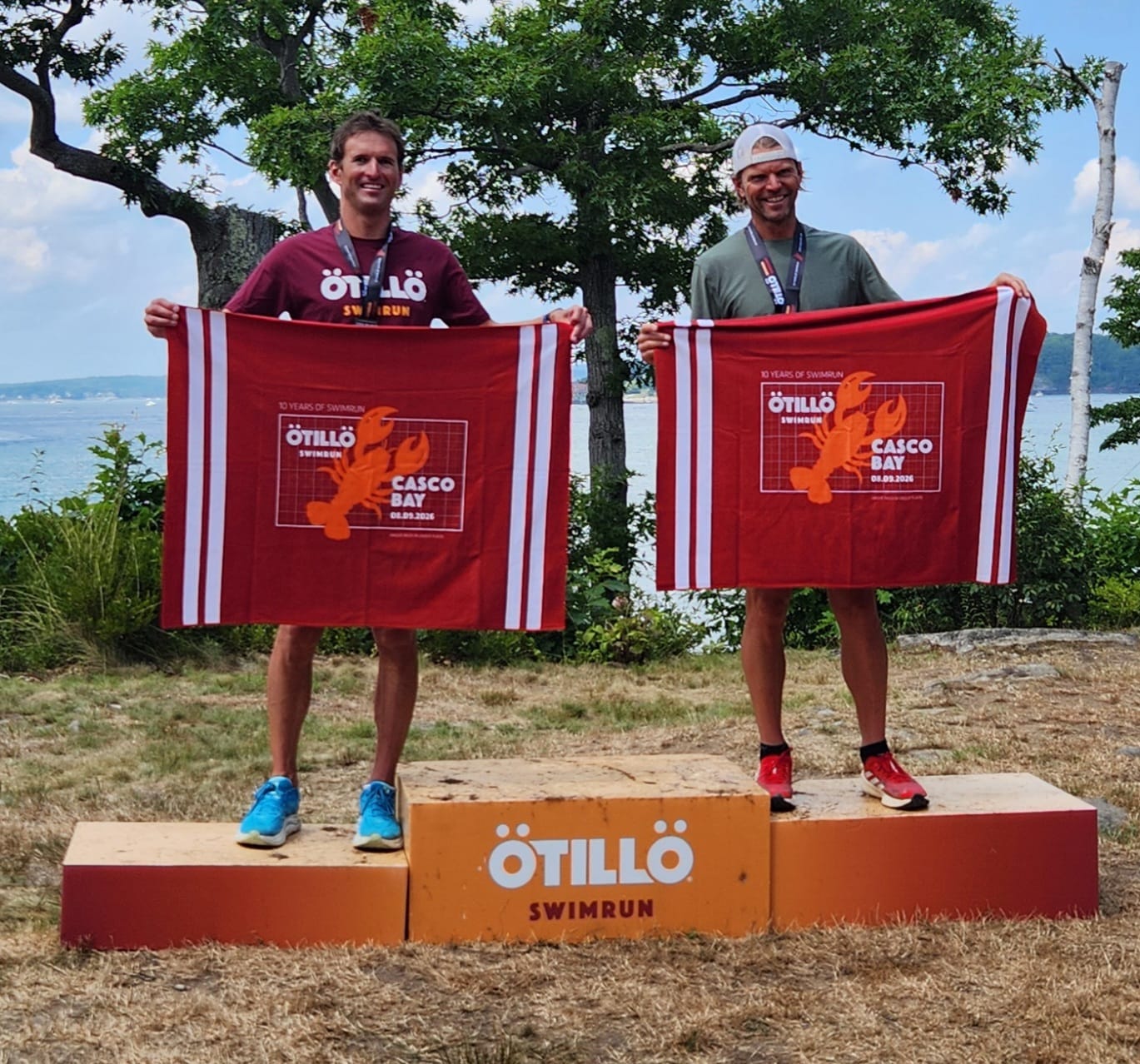
Last weekend, Steve and I traveled to Portland, Maine to race Ötillö Casco Bay. This was my third time at Casco and Steve’s first. My first year (2023) ended up being cancelled because of thick fog that never subsided throughout the day.
Last year, I raced with my friend Jacob from D.C. and we faced the exact opposite of what we would face in 2026: low tide. Casco Bay is a really unique race because the tides change the amount of running and swimming that athletes face on race day. In 2025, the low tide negated three swims in total (and became runs) and the swims that did exist were somewhat shorter on certain sections where the beaches became longer than they otherwise would have been.
During the 2025 edition, Jacob and I had to do some troubleshooting on the fly and it mostly centered around me. There is one swim entrance in the middle of the race that offers a dock jump from 15+ feet up, which is fun, but it also led to my pull buoy breaking off the cord, forcing me to essentially have to carry it by hand for the remainder of the race. There was also a point where my shoes got untied and ended up up in a weird knot. I was never able to completely fix it during the race, but I managed to get it somewhat workable after messing with it for a minute or so.
So there were a couple lessons from 2025 that Steve and I applied to 2026:
No dock jumps. Enter the swim on the lower dock to avoid broken pull buoys.
Have a better shoe tying system at the outset.
For 2026, the race was going to take place during high tide, which meant that the three swims that didn’t exist the year before would exist and some swims would be subject to strong currents, which were almost nonexistent in 2025. Moreover, the course had been adjusted in a couple locations making a couple swims longer than usual. All in all, we were looking at a swim-heavy race in comparison to other Ötillö events (the breakdown would be something like 8000+ meters swimming and 27K of running).
I don’t plan to take us through the whole race, but I want to highlight new setbacks and challenges that occurred in this year’s race, how we managed them, and discuss some broader ideas around troubleshooting on the fly.
First, right after the very first swim, Steve’s pull buoy cord came undone and needed to be retied. Not a huge deal, but the cord was a bit stuck and all this occurred at a point in the race where stopping to fix something can feel like it’s taking longer than it is because other racers are flying by. Nevertheless, we got it sorted, retied, and headed back onto the run.
Next, during the first longer swim, we got separated a bit and were not tethered at the time. When we got out of the water, we only had a short sandbar run to get the tether out and get attached before the next swim. This had happened to us at a race last year and getting tethered took us a very long time to sort out, but this time we were able to quickly get connected and proceeded forward in a matter of maybe 10 seconds.
Third, my soft flask top broke, meaning that my ability to carry water on the runs in between aid stations was gone. Interestingly, this happened to me at a race last year and I switched the type of soft flask that I chose to use to hopefully avoid this exact scenario again. I was able to keep the bottom of the flask which essentially meant that I had a reusable cup available. So for the rest of the race, I would just fill the flask quickly at aid stations and chug it. I also supplemented off Steve’s flask when needed.
Fourth, on the penultimate swim of the day, I was trying to hold the feet of another team (the Boston Wet Sox) for as long as I could, but during that process I swam way too close to a buoy in the bay. There are a lot of buoys all over the place for various reasons and because I was focused on holding feet, I lost sight of the bigger picture and swam straight into one. Normally, this might not be that big of a deal, but our tether ended up snagging on it and it caught us out like a boomerang clothesline. We had to stop and untangle ourselves before getting back out onto the course and finishing that swim.
And finally, while not one specific moment, there were various times where one of us dropped something and the other picked it up, and we both ran past turns where the other had to call out the other for course correction. There were also some crashes and falls during some of the swim exits and entrances, but I think that’s basically impossible to completely avoid given the terrain of a race like this. Slippery rocks and seaweed will always be slippery.
I bring up these various examples because I think it’s important to underscore the fact that setbacks and challenges will always happen in races. Last year’s setbacks were different from this year’s. Additionally, when you race as a team, the likelihood of setbacks goes up and you have to deal with them together.
So the skill set you want to develop is not about avoiding and mitigating any one setback, but about learning to continuously troubleshoot on the fly.
Some things that can help in this respect:
Communicate. I mean, this might seem obvious in the context of a team, but that doesn’t mean it still shouldn’t be said explicitly. We have to say what problems we are facing. What I also think is interesting in a team dynamic is that sometimes the teammate that does not have the setback occur to them can more easily see the solution. When we do something that sets us back, we can get caught up in the mistake or problem itself, whereas a secondary source might be more solution-oriented from the outset.
Slow down. In some cases, you need to slow down in order to speed up. There are a lot of things in races that are actually happening on autopilot in some ways. Even without a true flow state, there is a rhythm and predictive expectation taking place. When something suddenly happens outside of that predictive rhythm, you have to venture into new territory. This new territory needs some original, unique focus and when it is rushed, it can take even longer to complete a task. It sort of falls under the realm of motor skill learning models where someone goes through the stages of cognitive (requires a lot of focus), associative (skill is refined) and autonomous (skill is automatic). As we race, we are applying some of our autonomous skills and then we are suddenly thrown back into a cognitive phase to solve a new problem that we had not anticipated; trying to hurry and rush through it is often counterproductive as it makes us more clumsy.
You don’t always have to figure things out right away. When we get thrown curve balls we can sometimes strive to come up with a solution right away, but not everything has to have an immediate sense of urgency. If, and when, it doesn’t, I think it’s best to just keep rolling along until a solution comes to mind.
You should always expect setbacks, but you also need to accept that you cannot anticipate all of them. This is reflected in the idea of having the known unknowns and the unknown unknowns, as well as a quote I once heard that said “risk consists of everything you have not anticipated or accounted for.” Additionally, it should not be assumed that setbacks are only happening to you and not to others. Chances are, other competitors are dealing with their own setbacks, just maybe not at the same time or in the same way that you are experiencing.
The major upside: troubleshooting on the fly creates the moments we actually remember. I don’t think I will remember the swims on Sunday that went by smoothly, but I will always remember getting boomeranged by a buoy in the middle of the bay. Life is best lived in these moments.